Аннотация:
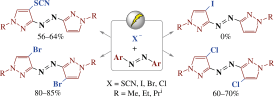
The anodic C–H functionalization of azopyrazoles [3,3'-(diazenediyl)dipyrazoles] with thiocyanate, bromide, and chloride anions, with or without ZnCl2 as a catalyst, affords the corresponding 4-thiocyanato or 4,4'-dihalo derivatives. The reactions proceed efficiently (56–85% yields) when the oxidation potentials of azopyrazoles and the anions (or their ZnII complexes) differentiate in ~0.1–0.6 V, so the iodo products are not formed. The products bearing SCN group possess antifungal activity, likely via inhibiting ergosterol biosynthesis, with the azo group enhancing this effect.


 Полный текст:
PDF файл (351 kB)
Полный текст:
PDF файл (351 kB)
 Первая страница:
PDF файл
Первая страница:
PDF файл
